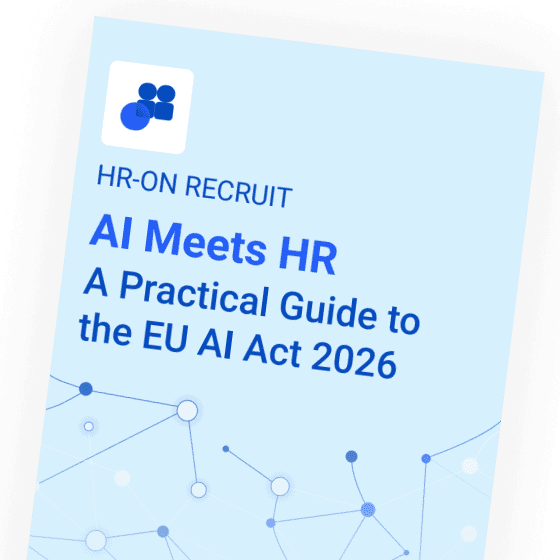
When AI Meets HR: A Practical Guide to the EU AI Act 2026
This EU AI Act guide for HR gives you a quick overview of the new requirements. In particular, it highlights what changes in 2026 for HR and recruitment. The EU AI Act is phased in gradually through 2027, and in August 2026 new obligations will apply to the use of AI in HR and recruitment.
If you want to keep working with AI in HR after the whitepaper, you can also explore our resources here: Recruitment 2026: HR-ON Recruit with AI and new tools.
EU AI Act guide
What do you get?
A short, practical guide to what the EU AI Act means for HR and recruitment – and how to adapt to the requirements.
What will you learn?
– When AI in HR falls under the rules
– What AI is not allowed to do in HR and employee-related contexts
– What HR needs in place: transparency, human oversight, documentation, bias controls, and data protection (GDPR)
Fill out and download
Fill out the form and receive the whitepaper by email. As a follow-up, we will also send you links to additional resources about AI in HR, the EU AI Act, and HR-ON’s HR solutions.
Moreover, you can already learn more about our recruitment system (HR-ON Recruit) and our other HR solutions.

What does the EU AI Act mean for HR and recruitment?
EU AI Act and HR – explained briefly
The EU AI Act aims to ensure fair, transparent, and responsible decision-making when AI impacts people. Therefore, the regulation is especially relevant in HR and recruitment, where AI can be part of assessing candidates and employees – for example through AI-supported recruitment systems and analytics tools.
Key obligations for HR teams
In practice, it often comes down to three things. First, you must be able to explain how AI is used. Second, a human must be able to override and remain accountable. Finally, you must document your setup and work actively with bias, data quality, and data protection. If you want to dive deeper into AI-enabled recruitment, you can also explore: Recruitment 2026: HR-ON Recruit with AI and new tools.
When is AI in HR covered?
The EU AI Act typically applies when AI supports or influences decisions in HR processes. In particular, this includes, for example, when you:
- Screen CVs or rank candidates
- Shortlist or reject applicants
- Analyse personality, behaviour, or performance
- Support decisions about hiring, promotion, or termination
- Assess well-being, risk, or behaviour among employees
If your use case touches employment-related decisions, it may fall under “high-risk” rules. In that case, use the EU’s official resources to navigate classification, including Navigating the AI Act (FAQ), the European Parliament’s overview, and the AI Act Service Desk.
How HR-ON Recruit and RecruitAI can help
Using AI tools in a compliant way
If you want to work more systematically with compliance in recruitment, it is crucial to have clear processes, solid data handling, and reliable documentation.
Therefore, with HR-ON Recruit, you get a recruitment flow that makes it easier to work structurally with candidate data, access control, and workflows. In addition, with RecruitAI, you can use AI in a way where transparency, human oversight, and responsible use become an integrated part of your setup and your preparation for the EU AI Act.
FAQ: Frequently asked questions about the EU AI Act in HR
What is the EU AI Act in short?
What is the EU AI Act in short?
The EU AI Act is the EU’s legal framework for regulating artificial intelligence based on risk level. The Act entered into force on 1 August 2024 and is rolled out gradually over the coming years, including specific requirements for high-risk AI systems – which can include many HR and recruitment use cases.
For more detail, see the official overview: AI Act and the announcement: AI Act enters into force.When is AI in HR covered by the EU AI Act?
When is AI in HR covered by the EU AI Act?
AI in HR is typically covered when it supports or influences decisions about candidates or employees – for example screening and ranking applicants, shortlisting and rejection, performance or well-being analytics, or automated recommendations related to hiring, promotion, or termination.
In many cases, systems may be classified as high-risk, which triggers stricter requirements for documentation, data quality, and human oversight. Therefore, you should use the EU’s FAQ to navigate definitions: Navigating the AI Act (FAQ).Which HR systems can fall under 'high risk'?
Which HR systems can fall under “high risk”?
Especially AI systems that can influence job opportunities or employment conditions – for example tools that screen and rank applicants, generate automated selection recommendations, analyse behaviour or performance, or allocate tasks based on profiling.
For an accessible overview, see the European Parliament’s explanation and, in addition, the AI Act Service Desk.Can we still use AI in recruitment after the EU AI Act?
Can we still use AI in recruitment after the EU AI Act?
Yes. The EU AI Act does not ban AI in general, but it introduces higher requirements for transparency, fairness, data security, and human oversight – especially for high-risk systems.
As a result, you can still use AI in recruitment and HR if you have documentation, solid data practices, and governance in place. For an overview of the regulation, see: Regulatory framework for AI.How does HR-ON work with EU AI Act compliance?
How does HR-ON work with EU AI Act compliance?
HR-ON builds on strong data protection and governance in our platforms, including GDPR work in HR-ON’s GDPR compliance.
In addition, we support transparency, human oversight, and documentation in workflows, so you can use HR-ON Recruit, RecruitAI and HR-ON Staff responsibly in light of the EU AI Act.What should the HR team do now?
What should the HR team do now?
A strong next step is an AI audit: map your AI systems, assess which could be high-risk, and establish processes for data governance, documentation, and human oversight.
After that, you can use the AI Act Service Desk and the implementation timeline to plan your efforts and, as a result, combine them with the practical HR angle from the whitepaper.
Want sparring on your AI setup in HR and recruitment?