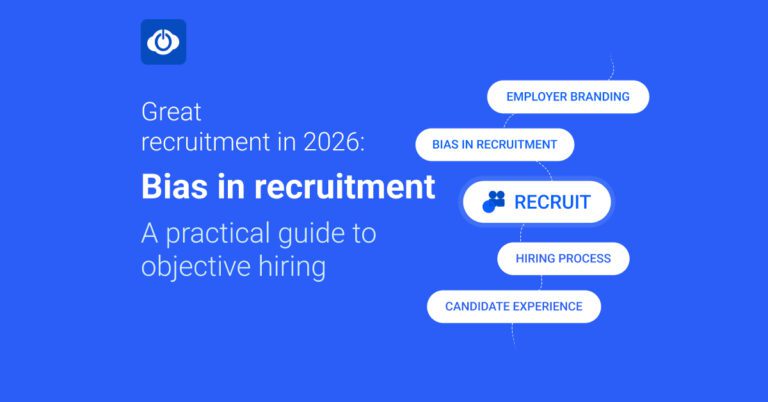
Chapter 4 of 4: Great recruitment in 2026
Bias in recruitment: A practical guide to objective hiring
What are you looking for when hiring? You may already know which competencies your new colleague should have, but what about the unspoken ones, the things you judge without even realizing it? Bias in recruitment is nothing new, but is it actually possible to recruit objectively? Read on for our guide.
When a company hires a new employee, the goal is to find the best candidate for the job. Yet many hiring decisions are influenced by something else entirely: bias in recruitment.
Small, unconscious judgments can sneak into the process. Maybe a candidate just “feels right.” Maybe an applicant reminds you of a former colleague. Or perhaps a name, age, or educational background influences your first impression.
The problem isn’t necessarily intention. The problem is that bias can make it harder to make objective decisions.
Welcome to chapter 4 in the series “Great Recruitment in 2026.” Here, we take a closer look at how you can work more structured and create more objective hiring decisions without making the process more complex.
What is bias in recruitment?
Bias in recruitment means our evaluations are influenced by unconscious assumptions or preferences that may not be related to the candidate’s competencies.
For example:
- Preferring candidates who are similar to yourself
- Letting a specific name or age influence your first impression
- Giving more weight to candidates from well-known universities
- Valuing personal chemistry over documented competencies
Bias is a natural part of human decision-making. But in recruitment, it can mean that the best candidate isn’t necessarily the one who gets the job. That’s why more organizations today actively work to make recruitment more structured and objective – something that can be done in different ways.
You are reading a chapter in our blog series: Great recruitment in 2026
A series where each chapter zooms in on an area you can work on to develop and improve your recruitment.
Right now, you are in:
Chapter 4 – Bias in recruitment: A practical guide to objective hiring
Also read:
Chapter 1 – Employer branding in 2026: Ready, set… hire!
Chapter 2 – 10 steps to a great candidate experience
Chapter 3 – Guide: How to create a strong recruitment process management
Why bias occurs in hiring processes
Recruitment is often a mix of data, experience, and gut feeling. The problem arises when gut feeling has too much influence.
Bias typically occurs in three situations:
1. Quick first impressions
When we skim a CV or application, we quickly form an opinion. Studies show that recruiters can form an opinion within seconds.
Here, we often see anchoring bias, where the first piece of information shapes the entire evaluation. At the same time, confirmation bias can come into play, as we subconsciously look for information that supports our initial impression.
Example: If a candidate starts their CV with a strong profile summary, it can influence your entire evaluation – even if the rest of the experience is average.
2. Lack of structure in evaluation
If all interviewers assess candidates differently, the decision becomes more subjective.
Here, contrast bias often occurs, where candidates are evaluated relative to each other instead of against fixed criteria. This means a candidate can appear stronger or weaker depending on who was interviewed just before them.
Example: A candidate may seem especially strong if they follow a weaker candidate.
3. Too much focus on “chemistry”
Good chemistry is important – but if it becomes the most important factor, it can lead to homogeneous teams.
Similarity bias plays a big role here, as we naturally connect better with people who are like ourselves. At the same time, the halo effect can occur, where a positive personal connection leads us to overestimate a candidate’s professional competencies.
Example: A candidate you have great chemistry with is perceived as more competent even without strong documentation.
Examples of common biases in recruitment:
There are many types of bias, but some of the most common in recruitment include:
- Confirmation bias: You unconsciously look for information that confirms your first impression
- Halo effect: One positive trait (e.g., previous employer) influences the overall evaluation
- Horn effect: One negative detail (e.g., a nervous start) affects the entire evaluation
- Similarity bias: You prefer candidates who are similar to yourself
- Contrast bias: Candidates are evaluated relative to each other rather than objective criteria
- Anchoring bias: First impressions become decisive for the overall evaluation
5 practical ways to reduce bias in recruitment
The good news is that reducing bias doesn’t require a complete overhaul of your recruitment process. Often, small changes can make a big difference.
Here are five methods many organizations use today:
1. Use a clear requirements profile
Start by defining:
- Which competencies are essential?
- Which experiences are “nice to have”?
- Which personal traits are important for the role?
- When requirements are clear from the beginning, it becomes easier to evaluate candidates on the same basis.
2. Structure the interview
A structured interview means all candidates receive:
- The same questions
- The same evaluation criteria
- The same interview format
This makes it easier to objectively compare candidates.
3. Consider blind recruitment
Blind recruitment means removing information such as names, ages, or genders from applications during initial screening.
The goal is to ensure that candidates are primarily evaluated on the basis of competencies and experience.
4. Use multiple evaluators
When several people are involved in evaluating candidates, decisions become less dependent on one person’s perspective.
For example:
- HR
- The hiring manager
- A future colleague
Different perspectives often lead to a more balanced evaluation.
5. Use technology to create structure
Digital recruitment tools can help:
- Standardize evaluations
- Collect feedback from interviewers
- Ensure documentation of decisions
Modern recruitment systems can support more objective assessments and reduce bias by implementing structured workflows and anonymized candidate views.
What do we do at HR-ON?
To minimize bias in recruitment, an important step (in addition to technology) is ensuring the recruitment team discusses the process. This helps everyone become aware of each other’s biases and jointly decide on the next steps in the recruitment process.
The role of technology in more objective recruitment
Today, technology plays a crucial role in reducing bias in recruitment. Where gut feeling once dominated, AI now makes it possible to work more structured, data-driven, and objectively. This can be done using HR-ON Recruit’s RecruitAI feature.
With RecruitAI, it becomes possible to anonymize information such as name, age, and graduation year, allowing candidates to be evaluated more on their competencies rather than their background – helping reduce classic biases such as similarity bias and perception bias.
At the same time, AI can assist in creating job postings by generating, improving, and translating content to make wording more inclusive. This can significantly impact who chooses to apply for the position.
Additionally, RecruitAI can help summarize applications, highlight relevant competencies, and match candidates to job requirements, ensuring a more consistent, data-driven evaluation.
This means decisions are based more on facts rather than first impressions, reducing the impact of biases such as the halo effect and confirmation bias.
Technology doesn’t eliminate bias entirely – but it creates a much stronger foundation for making less biased decisions, while also enabling more efficient and consistent recruitment processes.
How to move forward with a fairer recruitment process
If you want to work more actively with bias in recruitment, you can start with three simple questions:
- Do we have clear criteria for our hiring decisions?
- Do we evaluate candidates in the same way?
- Do we document our decisions?
Often, it’s not about changing everything – but about making what you already do more structured.
If you’re ready to try HR-ON Recruit with RecruitAI, you can book a demo or get a price estimate in just 2 minutes to get started.
In the series Great Recruitment in 2026, we have now covered four key areas:
Employer branding
The candidate experience
The hiring process
Bias in recruitment
Together, they form a strong, effective, professional, and fair foundation for recruitment.
FAQ: Bias in recruitment
What is bias in recruitment?
Bias in recruitment refers to unconscious prejudices or preferences that can influence how candidates are evaluated, leading to less objective hiring decisions.
Why is bias a problem in recruitment?
Bias can cause companies to overlook qualified candidates, resulting in less diversity and poorer hiring decisions.
How can bias in recruitment be reduced?
Bias can be reduced by using structured interviews, clear requirements profiles, multiple interviewers, and potentially blind recruitment.
Can technology reduce bias in recruitment?
Yes. Recruitment systems can help create structure, anonymize data, and ensure consistent evaluation criteria, which can reduce bias in recruitment.
How can RecruitAI reduce bias in recruitment?
With RecruitAI from HR-ON, you can use AI tools to anonymize candidate information so you are not influenced by bias during the evaluation process.