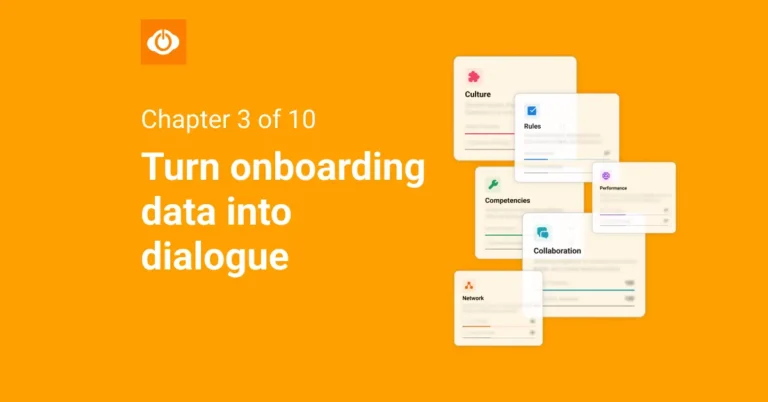
Chapter 3 of 10: Written by Christian Harpelund
From data to dialogue: What a dialogue report can do for your onboarding
This is the third article in a series about understanding and improving organizations’ ability to onboard new employees.
Short summary (TL;DR)
Data does not create change on its own. Only when the numbers are brought into a concrete onboarding dialogue can they help managers and employees understand why something is working — or not working — and what should happen next.
In this article, you’ll learn:
- why data alone cannot explain the reason behind a high or low score
- how a dialogue report turns measurements into concrete questions and next steps
- how the same data can strengthen the conversation with the individual employee and reveal patterns across the organization
- why the onboarding dialogue should change after one, three, and six months
In short: If you want real value from your onboarding data, it should not just end up in a report. It should be used to create the right onboarding dialogue at the right time — and lead to concrete actions that improve the employee’s onboarding experience.
A pattern no one had seen before
HR is looking at the numbers from a new measurement and spots something no one had noticed before: the experience of having sufficient network and social relationships consistently scores low for new employees in one particular department. Not because anyone complained. Not because a manager raised the alarm. But because the data reveals a pattern that no single person could have caught on their own.
That’s already valuable in itself. Simply noticing something you otherwise wouldn’t have seen is a gain from measuring at all.
Why let data sit unused when it can be put into play in the dialogue while it still matters?
You don’t have to wait for the pattern to be summarized in a quarterly report before the data becomes useful. The same numbers that reveal the pattern to HR can be used immediately — in the conversation that’s already happening between manager and employee.
You’re reading a chapter in our new blog series on understanding and improving organizations’ ability to onboard new employees.
You are currently reading: Chapter 3: From data to dialogue: What a dialogue report can do for your onboarding
Read also:
Chapter 1: Most organizations ask about satisfaction. That’s the wrong question
Chapter 2: Six dimensions, one model: What good onboarding actually looks like
Chapter 4: The index: How we track progress – and benchmark against others
Chapter 5: What benchmarks tell us about onboarding across age groups
Chapter 6: Six dimensions, six signals: What does a high or low score actually mean?
Chapter 7: The onboarding curve: The experience doesn’t just improve over time
Chapter 8: The onboarding calendar: Does it matter what time of year you hire?
Chapter 9: From diagnosis to action: How to build a catalog that matches the data
Chapter 10: From data to prediction: What AI can do for onboarding
Why numbers alone don’t create change
The six dimensions in the onboarding model (Harpelund, 2019) provide a precise picture of where onboarding succeeds and where it doesn’t. But a precise picture isn’t the same as a solution.
Numbers can point to a problem. They can’t explain it. Is the low network score due to the employee being isolated in a department with heavy remote-work days? Because no one introduced her to the right people? Or because she’s holding herself back out of uncertainty? Three very different causes — the same low score.
Without context, data is either ignored because no one knows what to do with it or misinterpreted because someone guesses at a cause that turns out to be wrong. Both are just as ineffective as not measuring at all.
What can a dialogue report do?
A dialogue report isn’t just a visualization of scores. It’s built to be used in a conversation — between manager and employee, and between HR and the organization as a whole.
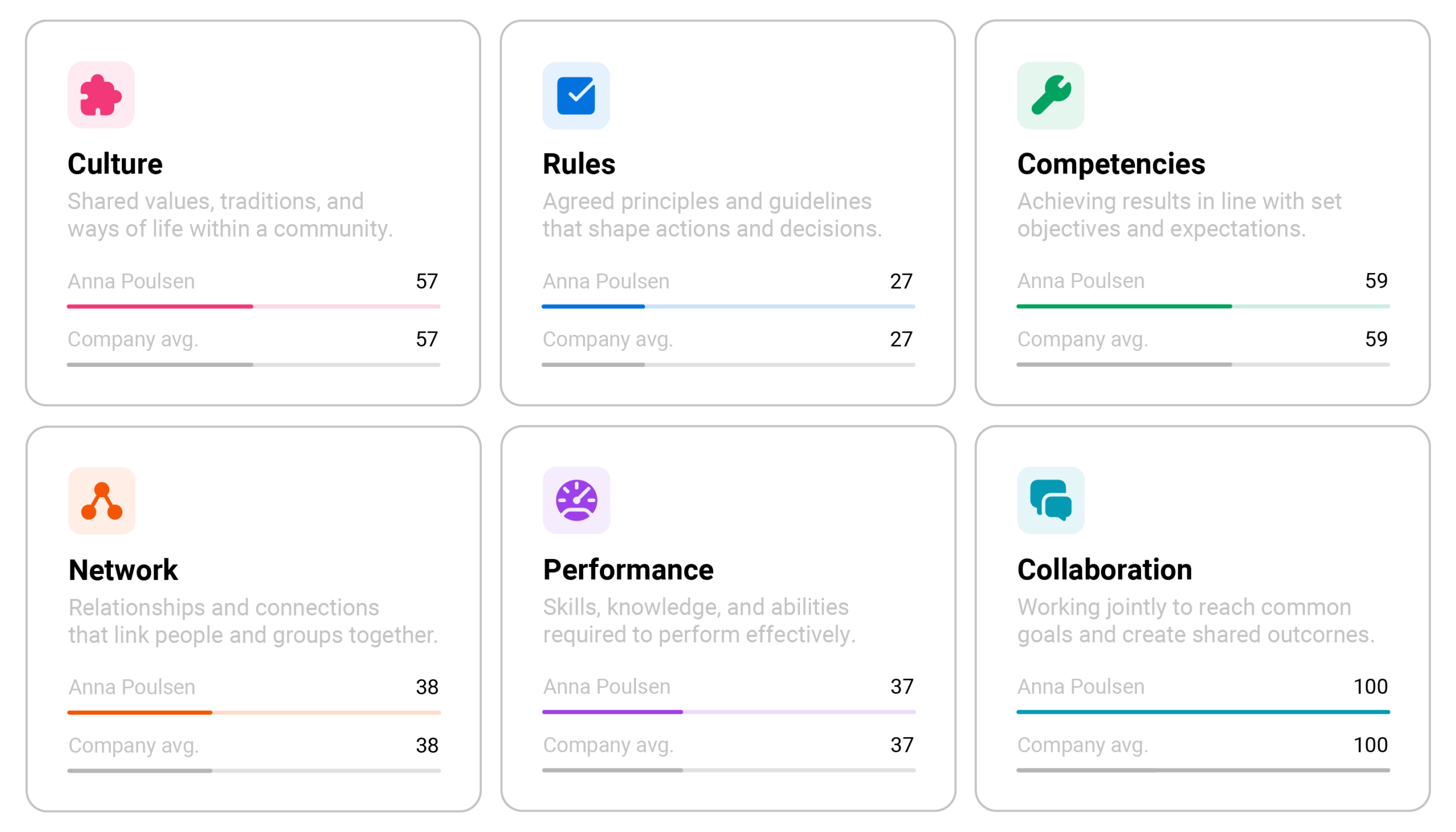
Example from a dialogue report: six onboarding dimensions compared with the company average. The report connects the scores to focused talking points and next actions.
THE CONCRETE CONVERSATION
The report links questions to each dimension, uncovers why a score looks the way it does, and points to realistic next steps.
THE STRUCTURAL PATTERN
Across employees, the same data reveals weaknesses in the onboarding itself that no single 1:1 conversation would uncover.
For the individual employee, that means the report doesn’t stop at the number. It includes concrete questions, tied to each dimension, that the manager and employee can use as the basis for the conversation — questions designed to uncover why a score looks the way it does, not just confirm that it does. And it points to concrete courses of action: if the network dimension is lagging, what’s a realistic next step — an introduction to a specific team, a dedicated sparring partner, access to an internal forum?
At the same time, the same data can be used at another level. When HR sees patterns across multiple employees — such as the network dimension scoring low across an entire department — that points not to one person’s individual experience, but to a structural weakness in the onboarding itself. That’s insight a single 1:1 conversation would never reveal on its own.
The dialogue report creates a concrete conversation at the small scale — and reveals patterns at the large scale.
A conversation that changes along the way
We’ve found it useful to collect data after one month, three months, and six months — and that’s not arbitrary. The conversation naturally shifts in character depending on where the employee is in the process.
1 MONTH
Align expectations
Adjust direction early, while it’s still easy.
3 MONTHS
Confirm or resolve
Confirm progress — or identify problems and actively help move things forward.
6 MONTHS
Land or support
Continue problem-solving — or shift into standard follow-up.
After one month, the conversation typically focuses on aligning expectations. The employee is still new enough that it’s about adjusting direction early, while it’s easy — not about resolving entrenched problems.
After three months, the conversation splits into two tracks, depending on what the data shows. If things are going well, it becomes a short conversation confirming that things are moving in the right direction. If they aren’t, it becomes a conversation with an entirely different focus: identifying the real problems and figuring out how to actively help the employee move forward.
After six months, that same pattern repeats with a different consequence. Either problem-solving continues because the challenges still haven’t been resolved — or the employee has landed, and the conversation naturally shifts to standard follow-up, because onboarding is, in practice, complete.
The dialogue report ensures that each conversation starts from what actually happened — not from a general sense of ‘how’s it going, really.’ The conversation shouldn’t spend time discovering what the data has already shown. It should spend time acting on it.
From report to action
A good conversation isn’t the goal in itself. The goal is for it to lead to something that actually changes the employee’s experience going forward.
That requires the report to do more than ask questions — it also needs to point toward direction. Not in the form of fixed, generic solutions — what resolves a low culture score in one department is rarely what resolves it in another. But in the form of a starting point: here’s what this dimension typically requires, and here’s what the two of you can agree on as a next step.
THE CRUCIAL SHIFT
Move from a report that gets read and set aside to a report that changes something in the employee’s everyday reality.
From snapshot to progress over time
Each dialogue report captures how things look at one specific point in time — after one month, three months, or six months. But how do you see the overall development across those three measurements? And how do you compare across teams, departments, or the whole organization?
That’s what a combined index can do, which a single report can’t. That’s the subject of the next article in the series. And before you read on, see how FastTrack can make a difference in your onboarding processes. FastTrack is part of HR-ON Onboarding.
This is the third article in a series about measuring and improving onboarding.
You might also like: 5 Tips for Employees and Managers: What Makes a Great Onboarding Program?
About the author
- Christian Harpelund is a qualified organizational psychologist and works with HR-ON as an onboarding expert
- He is the author of “Onboarding: Getting New Hires off to a Flying Start” and has a new book coming soon, “Kunsten at onboarde en leder” (in Danish)
- He delivers courses and gives talks on onboarding and the organizational frameworks that support effective leadership
FAQ: How can onboarding dialogue turn data into action?
What is an onboarding dialogue?
An onboarding dialogue is a structured conversation between a manager and a new employee, informed by data on the employee’s onboarding experience.
What is a dialogue report in onboarding?
A dialogue report turns onboarding measurements into concrete questions, talking points, and possible next steps for the manager and employee.
Why is onboarding data not enough on its own?
Data can show where a challenge exists, but it cannot explain why. The dialogue helps uncover the context behind a high or low score.
When should onboarding dialogues take place?
It can be useful to have them after one, three, and six months, as the focus naturally shifts from aligning expectations to solving challenges and following up on progress.