Chapter 8 of 10: Written by Christian Harpelund
The onboarding calendar: Does it matter what time of year you hire?
Eighth article in a series about understanding and improving organizations’ ability to onboard new employees.
Short summary (TL;DR)
The onboarding experience depends not only on the programme itself, but also on the time of year an employee starts. The data points to clear differences between the months of the year.
In this blog post, you’ll learn:
- why holidays, busy periods, and colleagues’ availability can affect onboarding
- how the organisation’s rhythm can make onboarding more vulnerable
- what you can do during the periods when the onboarding experience tends to be weakest
In short: When you understand your organisation’s seasonal rhythm, you can adapt the onboarding process and create a more consistent experience throughout the year.
Same role. Same program. Different starting month.
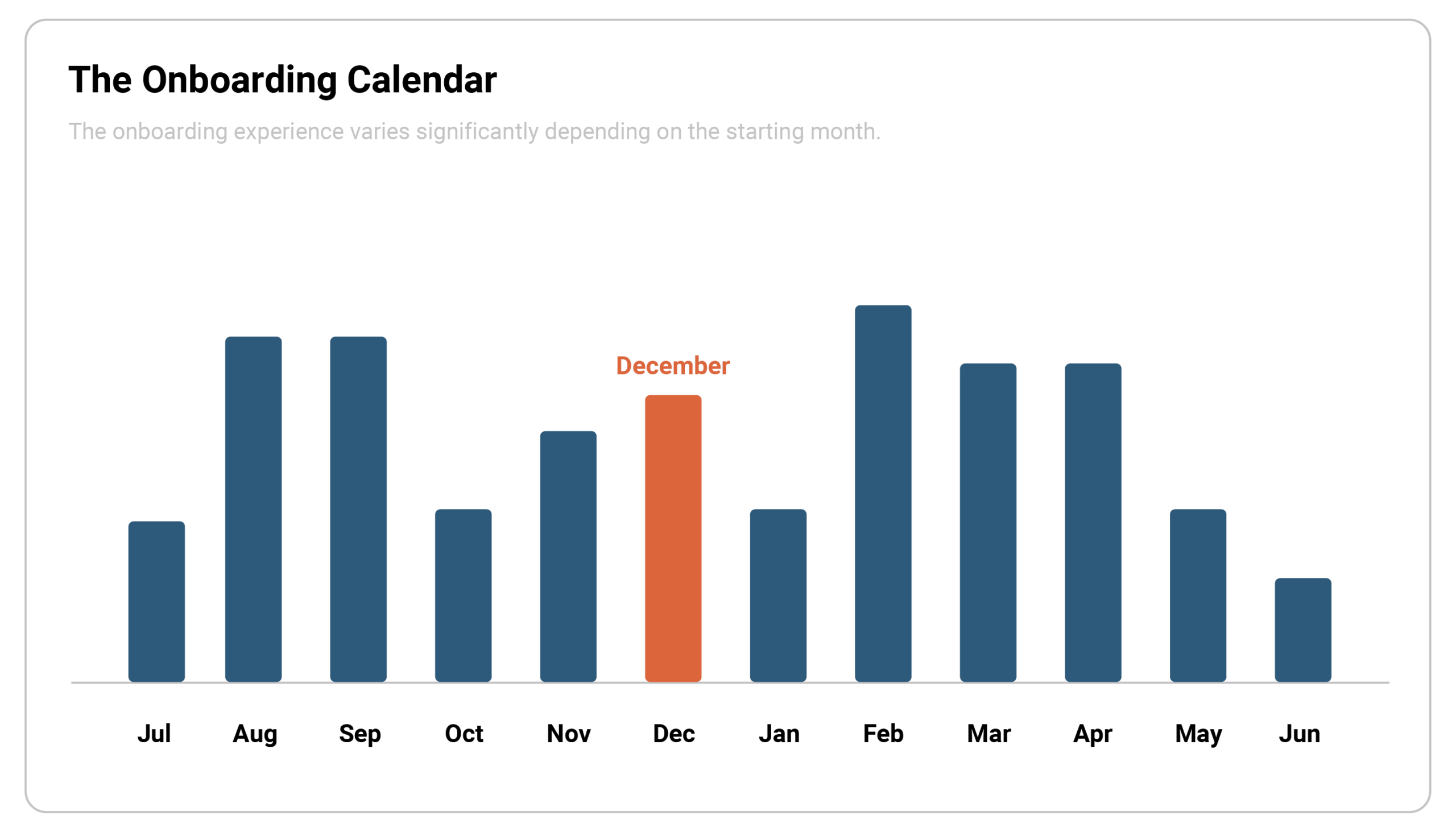
Two employees start in the same role, with the same onboarding program, in the same organization. One starts in February. The other in June. The data suggests they can end up with markedly different experiences — not because the program is different, but because the timing is.
A pattern that’s hard to ignore
When we look at organizations’ onboarding experience across the months of the year, the swing is often large. June and July tend to sit markedly lowest. February tends to sit high. Other months land somewhere in between.
The gap between the best and the worst time to start is large enough to be hard to ignore.
That’s not a small statistical blip, if you take your onboarding seriously.
You’re reading a chapter in our new blog series on understanding and improving organizations’ ability to onboard new employees.
You are currently reading: Chapter 8: The onboarding calendar: Does it matter what time of year you hire?
Read also:
Chapter 1: Most organizations ask about satisfaction. That’s the wrong question
Chapter 2: Six dimensions, one model: What good onboarding actually looks like
Chapter 3: From data to dialogue: What a dialogue report can do for your onboarding
Chapter 4: The index: How we track progress — and benchmark against others
Chapter 5: What benchmarks tell us about onboarding across age groups
Chapter 6: Six dimensions, six signals: What does a high or low score actually mean?
Chapter 7: The onboarding curve: The experience doesn’t just improve over time
Chapter 9: From diagnosis to action: How to build a catalog that matches the data – Coming soon
Chapter 10: From data to prediction: What AI can do for onboarding – Coming soon
Why would the time of year matter at all?
It makes intuitive sense that how you onboard matters. It’s less obvious that when would matter too — but a few hypotheses point to why it might work that way.
01 WORKLOAD AND RHYTHM
Most organizations have periods when there’s simply more going on than usual. A retailer may be especially busy in the run-up to the holidays. An accounting firm around year-end close. A public agency ahead of budget season. If a new employee starts in the middle of one of those periods, there’s less time to follow up, introduce, and explain.
02 HOLIDAYS
The lowest points may coincide with the summer holiday season. Colleagues are away on a rotating basis, the manager may be on leave part of the time, and the social and professional relationships onboarding often relies on are harder to build when half the team isn’t present.
03 TIME FOR COLLEAGUES
Even without holidays in the mix, timing affects how much time colleagues actually have for a new employee. An organization that’s just wrapped up a major project probably has more capacity than one that’s still in the middle of it.
ORGANISATIONENS RYTME THE ORGANIZATION’S RHYTHM
The causes aren’t identical everywhere. But every organization has a rhythm that the onboarding experience appears to follow.
The causes aren’t identical everywhere. But every organization has a rhythm that the onboarding experience appears to follow.
The hypotheses will certainly carry different weight from industry to industry — a retailer’s busiest period isn’t a manufacturer’s. The point isn’t that the causes are identical everywhere, but that every organization has a rhythm of its own.
If you manage onboarding across an organization with a clear seasonal cadence — a fiscal year-end, a peak sales season, an academic calendar — this is worth checking directly against your own data rather than assuming it doesn’t apply to you.
What it means for your onboarding design
The interesting question isn’t just whether there’s seasonal variation — it’s what that variation reveals about your own onboarding design.
If onboarding is built heavily around relational elements — introductions, social events, close support from colleagues — it’s worth asking yourself: what happens to those elements during the periods when colleagues don’t have time? A design that assumes the organization has spare capacity to carry the relational side will naturally underperform in the months when that capacity isn’t there. That’s not necessarily an argument for removing the relational elements — they’re often among the most important — but it is an argument for having a plan B for the periods when they can’t be fully carried through.
The same holds if onboarding leans heavily on specific key people — a manager who personally introduces every new hire, or a single colleague who serves as the go-to “buddy” for everyone new in the department. If that person is on holiday, tied up with a deadline, or under pressure themselves during a busy stretch, onboarding loses its footing precisely where it depends most on one individual.
THE DESIGN’S VULNERABILITY
The program can look identical on paper — and still be far more vulnerable in certain months.
The program can look identical on paper — and still be far more vulnerable in certain months.
From observation to action
There are, at bottom, two paths once you know your own seasonal calendar:
01 MOVE THE START DATE
Try to avoid hiring during the weakest periods, where possible. Not always realistic — but worth considering for roles with flexibility in start date.
02 REDESIGN THE PERIOD
Make onboarding less dependent on individual people. Add self-driven or digital elements, and explicitly schedule follow-up for when the organization has more capacity again.
That leads to a broader question: if you know which elements of onboarding are vulnerable — to season, to key people, to workload — how do you build a design that’s resilient to them? That takes more than knowing when the problems arise; it takes an actual catalogue of interventions you can draw on, depending on what the situation calls for. That’s the subject of the next article in the series.
If you’re responsible for onboarding across several teams or regions with different seasonal rhythms, that catalogue is likely to matter more to you than a single fixed program ever could — it’s what lets the same underlying design flex to fit each team’s own calendar.
Learn how the FastTrack tool can improve your onboarding processes. FastTrack is part of HR-ON Boarding+.
THE CRUCIAL SHIFT
Move from one onboarding design for the whole year to a design that can carry the organization’s changing rhythm.
Move from one onboarding design for the whole year to a design that can carry the organization’s changing rhythm.
This is the eighth article in a series about measuring and improving onboarding.
About the author
- Christian Harpelund is a qualified organizational psychologist and works with HR-ON as an onboarding expert
- He is the author of “Onboarding: Getting New Hires off to a Flying Start” and has a new book coming soon, “Kunsten at onboarde en leder” (in Danish)
- He delivers courses and gives talks on onboarding and the organizational frameworks that support effective leadership
Does it matter for the onboarding experience what time of year an employee starts?
Why can the onboarding experience vary throughout the year?
Because the organisation’s rhythm changes. Busy periods, holidays, and colleagues’ availability can affect how much time and attention can be given to a new employee.
Which months seem to be the most challenging for onboarding?
The data suggests that June and July often score lower, while February often scores higher. However, the pattern may vary from one organisation to another.
What makes an onboarding design vulnerable during certain periods?
An onboarding design can become vulnerable if it relies heavily on relationship-based activities or on specific key people, such as managers and buddies. If they are unavailable, the onboarding experience may be weaker.
How can onboarding be adapted to the organisation’s seasonal rhythm?
You can either try to avoid start dates during the weakest periods or redesign the onboarding process so that it is less dependent on individual people and better able to work across both busy and quieter periods.