Chapter 10 of 10: Written by Christian Harpelund
From data to prediction:
What AI can do for onboarding
Tenth and, for now, final article in a series about understanding and improving organizations’ ability to onboard new employees.
Short summary (TL;DR)
- 56% of organizations working with HR data primarily use it to describe what has already happened. The next step is to use data to understand patterns, predict what is going to happen, and act earlier.
- AI can combine several data sources and detect patterns before they show up as problems. This can include the employee’s own development, the organization’s typical onboarding curve, segment data, and the interventions the employee has already gone through.
- Predictions become especially valuable when they are linked directly to action. If the data suggests that an employee is heading toward a dip, the system can suggest a relevant onboarding intervention before the problem fully sets in.
- Personality tests can make onboarding more personal. Combined with other onboarding data, they can provide a more precise picture of the kind of support an individual employee is likely to need.
- AI in onboarding requires transparency and a clear purpose. Predictions should be used to support the employee and give managers a better basis for acting on the right signals.
In short: AI can move onboarding from explaining what has already happened to predicting what is about to happen — and make it possible to act before it becomes a problem.
56% can describe the past.
The ladder goes much further.
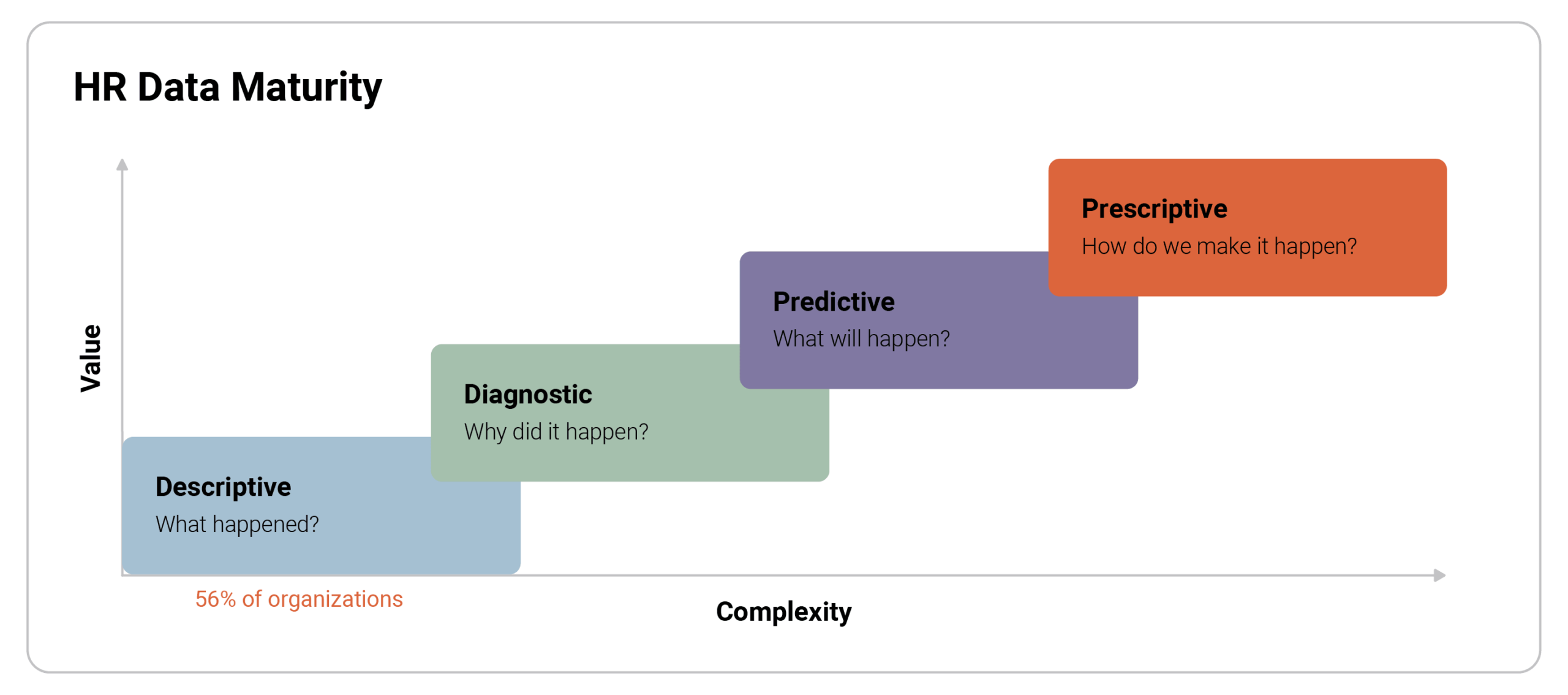
56% of organizations working with HR data sit on the same rung: they can describe what happened. They can see that an employee scored low on Culture, or that the onboarding experience dipped after four months. That’s valuable — but it’s also only the first step on a ladder that reaches much further.
If you’ve spent any time in this group, you’ve likely already moved past pure description — you’re reading dimension scores, you’re spotting the dip in the curve. This article is about what the next rungs of that ladder actually look like, and what it takes to reach them.
Four steps, one ladder
HR data maturity can be described as four steps, each answering a different question and delivering a different kind of value.
You’re reading a chapter in our new blog series on understanding and improving organizations’ ability to onboard new employees.
You are currently reading: Chapter 10: From data to prediction: What AI can do for onboarding
Read also:
Chapter 1: Most organizations ask about satisfaction. That’s the wrong question
Chapter 2: Six dimensions, one model: What good onboarding actually looks like
Chapter 3: From data to dialogue: What a dialogue report can do for your onboarding
Chapter 4: The index: How we track progress – and benchmark against others
Chapter 5: What benchmarks tell us about onboarding across age groups
Chapter 6: Six dimensions, six signals: What does a high or low score actually mean?
Chapter 7: The onboarding curve: The experience doesn’t just improve over time
Chapter 8: The onboarding calendar: Does it matter what time of year you hire?
Chapter 9: From diagnosis to action: How to build a catalog that matches the data
1 DESCRIPTIVE
What happened?
2 DIAGNOSTIC
Why did it happen?
3 PREDICTIVE
What’s going to happen?
4 PRESCRIPTIVE
How do we make it happen?
The first step is descriptive: what happened? This is where most organizations sit — you can see the numbers, but not necessarily understand or act on them. The second step is diagnostic: why did it happen? This is where you start to understand patterns — why the experience typically dips after four months, why one department scores lower than another. The third step is predictive: what’s going to happen? Here, you use the patterns to predict how things will likely go for an individual employee, before it happens. And the fourth step is prescriptive: how do we make it happen? This is where data turns into action, automatically and proactively.
The series has climbed the same ladder
This article series has, in practice, followed the same ladder. The early articles were about measuring and describing (the index, the dialogue report). Diagnosis followed (benchmarks, dimension signals, the onboarding curve, seasonal variation). With the catalogue in the previous article, we moved toward the prescriptive step — concrete interventions, ready to be deployed. What’s missing to close the loop is the predictive step: using everything we already know to predict what’s about to happen — before it shows up as a low score.
THE NEXT STEP
This is where AI enters the picture.
What AI can actually combine
What makes prediction possible isn’t a single data source — it’s the combination of several.
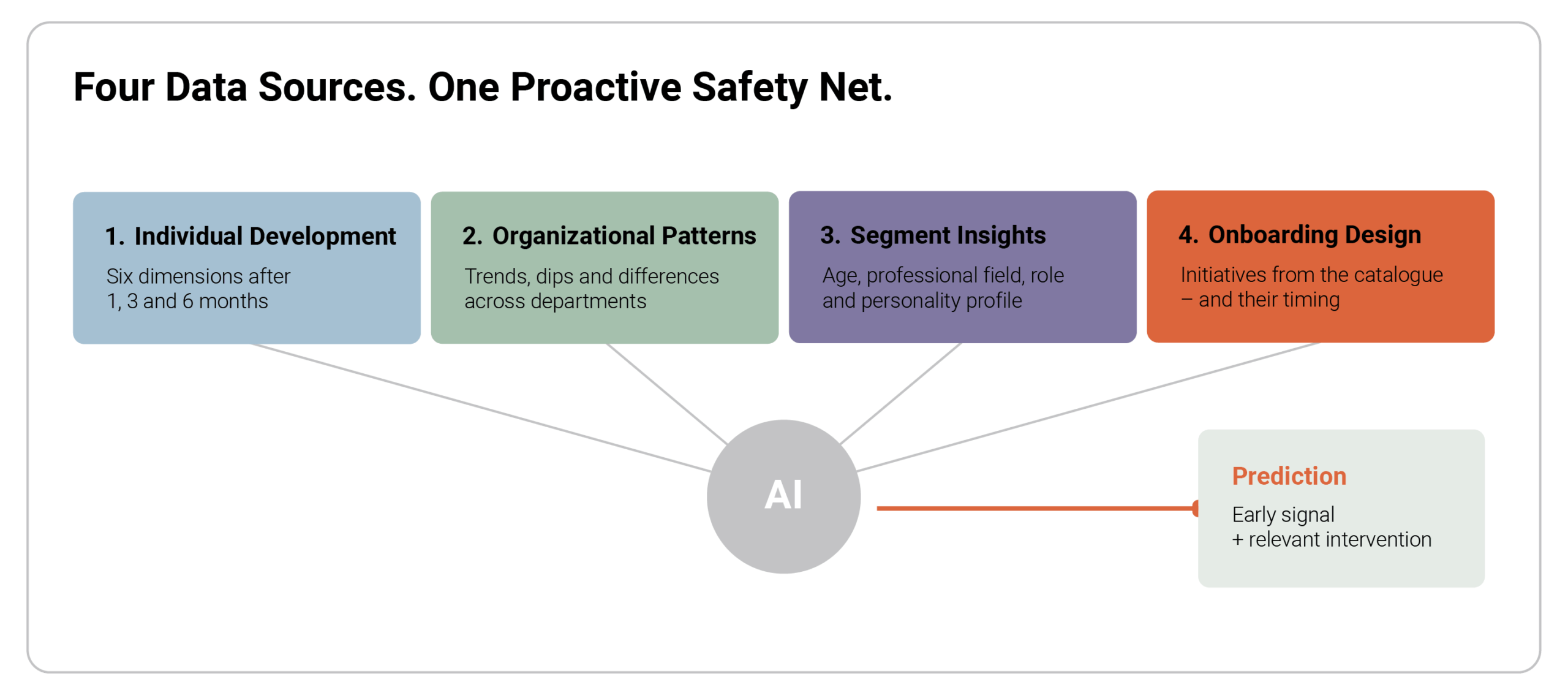
If you know the employee’s own development so far in the process: scores on the six dimensions after 1, 3, and 6 months. If you know the department’s or organization’s typical pattern: the characteristic curve, with its dips and rises, and how it usually looks compared to the rest of the organization. If you know segment data: how employees in a specific age group, professional field, or role type typically perform. And if you know — provided you’ve been structured about it — exactly which onboarding design the individual employee has actually gone through: which interventions from the catalogue were deployed, and when.
Combine those four data sources, and you have something far more useful than a single score. You can start to ask: is this employee on a trajectory that historically leads to a problematic dip in two months? And if so — what usually works in that situation?
THE NEW QUESTION
Is this employee on a trajectory that historically leads to a problematic dip — and what usually works there?
From prediction to an automatic safety net
This is where the catalogue from the previous article becomes especially valuable. If you’ve already built a catalogue of interventions, organized by dimension and phase, the AI prediction can be linked directly to action: if the system predicts an employee is heading toward a dip in the Network dimension, it can automatically suggest — or even trigger — the relevant intervention from the catalogue before the dip fully sets in.
That’s the difference between a safety net you have to remember to set up yourself, and one that’s set up automatically when the data shows it’s needed. For an individual manager, it means no longer having to manually track every signal — the system does it, and flags it when something calls for action.
A PROACTIVE SAFETY NET
The system watches the signals and alerts the manager when something calls for action.
If you’re overseeing onboarding across multiple teams, this is arguably where AI adds the most leverage: it’s the difference between one manager keeping a mental tally of a handful of new hires, and a system consistently tracking the same signals across every team, every hire, all at once.
The overlooked data source: personality tests
There’s a data source most organizations already have on hand but rarely use for this purpose: personality tests from the recruitment process.
Most organizations that hire in a structured way already test candidates during recruitment — and, in doing so, get a picture of how the person typically operates, what motivates them, and what kind of support they need. That picture is typically used once, in the hiring decision itself, and then filed away.
You already have data on what the person is likely to need — but it isn’t being used where it could do the most good.
That’s a paradox. You already have data on what this specific person is likely to need in order to thrive — but it isn’t being used to shape onboarding, which is exactly the moment when that knowledge would be most useful. An employee who, according to their profile, thrives with structure and clear boundaries probably needs something different in their onboarding than one who thrives on freedom and fast-paced challenges.
Connect that kind of segment insight to the other data sources — the employee’s own development, the organization’s pattern, the catalogue of interventions — and prediction shifts from generic to personal. Not ‘this age group typically needs X,’ but ‘this person, with this profile, in this role, at this time of year, has historically needed Y.’
Handle this with care
It’s worth saying plainly: the more precisely you can predict how a specific employee is doing, the more important it becomes to use that knowledge to help — not to monitor. The purpose of this kind of AI is to catch signals early enough to act supportively, not to add another layer of control to the employee’s day-to-day. It requires transparency about which data is used, and for what — and it requires that the employee experiences the prediction as something working in their favor.
PURPOSE
Support — not surveillance
TRANSPARENCY
Be clear about the data and how it’s used
PEOPLE FIRST
Use the prediction for the employee’s benefit
Where the series has taken us
We started this series with a simple question: why is satisfaction the wrong thing to measure? Along the way, we built on it step by step — from six dimensions, to dialogue reports, to an index, to benchmarks, to the curve, to the calendar, to a catalogue of concrete interventions. Each step made the next one possible.
THE LOOP CLOSES
From measuring what happened, to predicting what’s about to happen — and acting before it becomes a problem.
With AI, the loop closes: from measuring what happened, to predicting what’s about to happen — and acting on it before it becomes a problem. This is no longer just a question of understanding your onboarding better. It’s a question of building an onboarding that actively looks out for every single employee, the whole way through.
THANK YOU FOR FOLLOWING ALONG
This was, for now, the final article in the series about measuring and improving onboarding.
Improve your onboarding processes with FastTrack. FastTrack is part of HR-ON Boarding+.
You might also like: From data to dialogue: What a dialogue report can do for your onboarding
About the author
- Christian Harpelund is a qualified organizational psychologist and works with HR-ON as an onboarding expert
- He is the author of “Onboarding: Getting New Hires off to a Flying Start” and has a new book coming soon, “Kunsten at onboarde en leder” (in Danish)
- He delivers courses and gives talks on onboarding and the organizational frameworks that support effective leadership
FAQ: How can AI be used to improve onboarding?
What can AI be used for in onboarding?
AI can be used to detect patterns in onboarding data and predict where an employee may need additional support. This makes it possible to act earlier in the onboarding process.
What data can AI use in onboarding?
AI can combine the employee’s own scores, the organization’s typical onboarding patterns, segment data, and the interventions the employee has already gone through as part of their onboarding.
How can AI support managers in practice?
AI can alert managers to signals that point to an upcoming need and suggest relevant interventions. This gives managers a better basis for supporting the employee at the right time.
How can personality tests be used in onboarding?
Personality tests can provide insight into the kind of support, structure, and challenges an individual employee is likely to thrive with. Combined with onboarding data, this can make the onboarding experience more personal.
What does it mean to work predictively with onboarding data?
It means using historical patterns to assess how an onboarding process is likely to develop. This allows HR and managers to act before a challenge grows into a bigger problem.
What is important when using AI in onboarding?
Transparency and a clear purpose are essential. Employees should know which data is being used and for what purpose, and AI insights should be used to provide better support throughout the onboarding process.