
Maximizing Employee Satisfaction and Loyalty: Employee Net Promoter Score (eNPS)
Employee satisfaction and loyalty are critical components of a successful organization. When employees are happy and engaged in their work, they are more likely to be productive, supportive of the company’s goals, and committed to its success. One tool that organizations can use to measure employee satisfaction is the Employee Net Promoter Score (eNPS).
In addition to traditional measures of satisfaction, organizations should also prioritize the wellbeing and mental health of their employees to create a positive work environment. In this article, we will explore the role of eNPS and wellbeing in maximizing employee satisfaction and loyalty.
Short summary (TL;DR)
Employee Net Promoter Score (eNPS) is a simple way to measure employee satisfaction and loyalty, but the score should never stand alone. To understand how employees really feel, organizations also need to look at wellbeing, mental health and the wider employee experience.
In this article, you will learn:
- What Employee Net Promoter Score (eNPS) is and how it works
- How promoters, passives, and detractors affect your eNPS
- Why eNPS is useful for measuring employee satisfaction and loyalty
- Why wellbeing and mental health should be considered alongside eNPS
In short: Use eNPS as a starting point, not the full picture. Combine the score with employee feedback and wellbeing insights to better understand where your organization is doing well and where there is room for improvement.
What is Employee Net Promoter Score (eNPS)?
Employee Net Promoter Score (eNPS) is a tool organizations use to measure employee satisfaction and loyalty. It is based on a simple question: “On a scale of 0 to 10, how likely are you to recommend this company as a place to work to a friend or family member?” The responses are then grouped into three categories: promoters, passives, and detractors.
Promoters are employees who give a score of 9 or 10 and are likely to recommend the company to others. These employees are highly engaged and satisfied with their work and are likely to go above and beyond to support the company.
Passives are employees who give a score of 7 or 8. These employees are generally satisfied with their work, but they may not be as committed or engaged as promoters.
Detractors are employees who score 0 to 6. These employees are unhappy with their work and are likely to spread negative feedback about the company.
How to calculate your eNPS
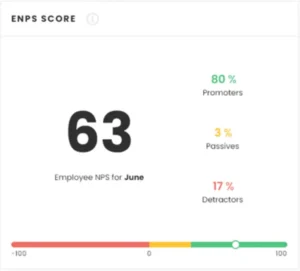
To calculate the eNPS, subtract the percentage of detractors from the percentage of promoters. For example, if 50% of employees are promoters and 10% are detractors, the eNPS would be 40. A positive eNPS indicates that the organization has more promoters than detractors, while a negative eNPS indicates the opposite.
Why is eNPS important for organizations?
eNPS can be a valuable tool for organizations because it provides insight into employee satisfaction and loyalty. By regularly surveying employees and tracking eNPS over time, organizations can identify areas for improvement and take steps to increase employee engagement and satisfaction. This can lead to increased productivity, reduced turnover, and improved customer satisfaction.
eNPS should not stand alone
eNPS can be a valuable tool for organizations because it provides insight into employee satisfaction and loyalty. By regularly surveying employees and tracking eNPS over time, organizations can identify areas for improvement and take steps to increase employee engagement and satisfaction. This can lead to increased productivity, reduced turnover, and improved customer satisfaction.
However, it is important for organizations to use eNPS as just one piece of the puzzle. It is also important to gather more detailed feedback from employees and to consider other factors that may impact employee satisfaction, such as workload, management, and company culture. By taking a holistic approach to understanding and improving employee satisfaction, organizations can create a positive work environment that supports the success of both the organization and its employees.
You might also like: 5 Ways to Improve Employee Wellbeing (Without a Huge Budget)
Employee wellbeing goes beyond satisfaction scores
In addition to traditional measures of employee satisfaction, organizations should also pay attention to the wellbeing and mental health of their employees. A positive work environment should prioritize employees’ physical and mental health, as this can lead to increased productivity and job satisfaction. This may include providing stress-management resources, offering flexible work arrangements, and promoting a healthy work-life balance.
In conclusion, eNPS is a useful tool for measuring employee satisfaction and loyalty. However, it is important for organizations to consider a range of factors that may impact employee satisfaction, including workload, management, company culture, and wellbeing. By prioritizing the satisfaction and wellbeing of employees, organizations can create a positive work environment that supports the success of both the organization and its employees.
Turn employee feedback into action
At HR-ON, we understand the importance of eNPS and employee wellbeing; that’s why our solution supports many different templates for a range of popular surveys, such as eNPS, Workplace Assessment, Social Capital, and WHODAS. They have been built in and are ready to be enabled – and if these do not cut it, you can always use our editor to design your very own.
Want to learn more about eNPS and employee satisfaction? Contact us for more information on how to measure and improve wellbeing and eNPS at your organization.
What should you know about eNPS and employee satisfaction?
What is eNPS?
eNPS is a metric used to measure employee satisfaction and loyalty based on how likely employees are to recommend the organization as a place to work.
How is eNPS calculated?
The percentage of detractors is subtracted from the percentage of promoters. The result is the organization’s eNPS score.
What is a good eNPS score?
A positive eNPS means that the organization has more promoters than detractors. The score should, however, be interpreted together with other employee feedback.
Why should wellbeing be measured alongside eNPS?
Because eNPS alone does not give the full picture. Wellbeing, mental health, workload, management, and company culture can all affect employee satisfaction and loyalty.