
Chapter 2 of 10: Written by Christian Harpelund
Six dimensions, one model: What good onboarding actually looks like
Second article in a series about understanding and improving organizations’ ability to onboard new employees.
Short summery (TL;DR)
Good onboarding isn’t about one single experience. A new employee can be doing well in some areas while still lacking crucial support in others.
In this blog post, you’ll learn:
- the six dimensions that together create a good onboarding experience
- why culture, rules, network, collaboration, skills, and results should be measured separately
- how challenges in one dimension can affect several others
- why six precise measurement points give a more useful picture than a single overall score
In short: If you want to understand where your onboarding is working – and where it’s breaking down – you need to look at the employee’s needs across all six dimensions. This makes it easier to target improvements exactly where they’re needed.
An employee can love her manager, fully understand her tasks, and still be fumbling three months in — because no one introduced her to the informal network that actually gets things done. Another can have every system and procedure down cold from day one, yet never quite understand why the organization does things the way it does — and keep bumping into invisible norms as a result.
Onboarding doesn’t succeed or fail in one place. It succeeds or fails in several places at once — simultaneously, and partly independently of each other.
If you’ve worked with onboarding yourself, you’ve likely seen this pattern yourself: a new hire who seems to be doing fine on paper, but who’s quietly struggling somewhere you can’t quite name. That’s usually not a sign that onboarding failed entirely. It’s a sign that it succeeded in some dimensions and fell short in others — and a single overall impression won’t tell you which.
In the previous article, we argued that you should measure experience rather than satisfaction. But experience isn’t one large, fuzzy concept. It’s six concrete dimensions you can point to precisely.
You are currently reading: Chapter 2: Six dimensions, one model: What good onboarding actually looks like
Read also:
Chapter 1: Most organizations ask about satisfaction. That’s the wrong question
Chapter 3: From data to dialogue: What a dialogue report can do for your onboarding – Coming soon
Chapter 4: The index: How we track progress – and benchmark against others – Coming soon
Chapter 5: What benchmarks tell us about onboarding across age groups – Coming soon
Chapter 6: Six dimensions, six signals: What does a high or low score actually mean? – Coming soon
Chapter 7: The onboarding curve: The experience doesn’t just improve over time – Coming soon
Chapter 8: The onboarding calendar: Does it matter what time of year you hire? – Coming soon
Chapter 9: From diagnosis to action: How to build a catalog that matches the data – Coming soon
Chapter 10: From data to prediction: What AI can do for onboarding – Coming soon
Why one overall experience score isn’t enough
If you only ask generally about ‘your onboarding experience,’ you risk getting an average that hides more than it reveals. An employee who’s strongly anchored socially but completely at sea professionally can still land on a decent overall score — without anyone noticing where things are actually breaking down.
That’s why we work with a model built on six dimensions. Each one covers a distinct need a new employee has in order to succeed. And critically: you can easily score high on some and low on others. That’s precisely what makes the model useful — it shows exactly where effort needs to go.
It’s worth pausing on why this matters more than it might first appear. Most organizations already sense, informally, that onboarding is multi-dimensional — nobody genuinely believes that a single welcome event fixes everything. But sensing it and being able to act on it are different things. Without a structured model, ‘onboarding is complicated’ stays a vague intuition instead of something you can diagnose and improve.
The six dimensions
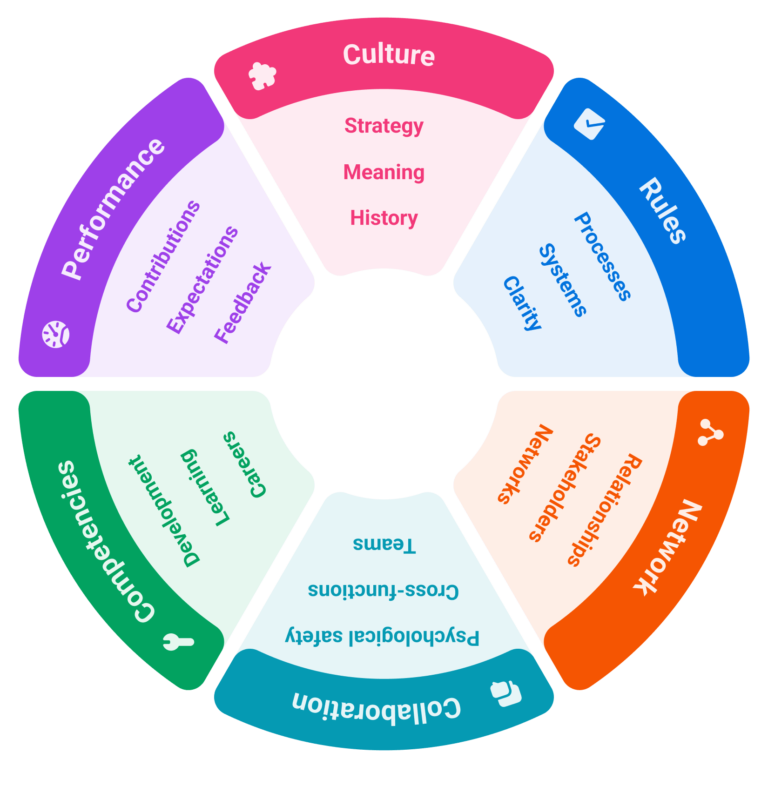
What the six dimensions reveal
CULTURE
Understanding the organization’s history, norms, and values — along with insight into direction, vision, and strategy. But also the unwritten rules that no one writes down, yet everyone expects you to know. Culture is often the dimension that takes longest to learn — and the one least often taught explicitly.
RULES
Understanding your role and the expectations that come with it. Understanding rules and procedures — and, crucially, actually being able to use and leverage the systems you have access to. You can easily be handed a login without understanding how to use the system effectively.
NETWORK
Building social relationships and gaining access to relevant networks — and being able to navigate the groupings that shape how work actually gets done. This is often the dimension that determines how quickly an employee gains access to informal knowledge and help.
COLLABORATION
Working with your closest manager, with colleagues — and across functions. Knowing your own tasks is one thing. Knowing how to work with others on them is another.
COMPETENCIES
Understanding the organization’s jargon and terminology, getting the right level of challenge and development — and being allowed to actually use the competencies you already bring with you. Many new employees experience a vacuum here: they have something valuable to offer, but no one has made space for it yet.
RESULTS
Understanding what’s expected of your results, being able to prioritize your tasks — and experiencing that what you deliver genuinely matters. Without this dimension, even the most well-integrated employee can end up feeling redundant.
For those of you who’ve spent years thinking about onboarding, none of these six will feel unfamiliar as concepts. What changes is having them named, separated, and treated as distinct — instead of folded into one general sense of ‘how it’s going.’
Six dimensions, one connected picture
The core of the model isn’t just that there are six dimensions — it’s that they’re connected. An employee who doesn’t understand the culture will often also struggle to navigate the network, because the informal rules of the game are tied together. An employee who isn’t allowed to use their competencies will often experience their results as feeling less valuable — because they’re operating below their capability.
Weakness in one place rarely stays isolated.
That’s why a single satisfaction score falls so short: it captures neither where the problem sits, nor how it spreads.
From one average to a precise picture
Measuring all six dimensions at once gives you a precise picture instead — not just whether onboarding “works,” but where it works, and where it doesn’t.
THE CRUCIAL SHIFT
Move from one average to six precise conversations about where onboarding is succeeding — and where it is breaking down.
That picture is only useful if it can be turned into something people can actually act on. That’s where data stops being numbers in a spreadsheet and becomes something managers and employees can genuinely talk about. That’s the subject of the next article in this series.
This is the second article in the series on measuring and improving onboarding. Read about our FastTrack tool in HR-ON Boarding+ here and see how you can gain valuable insight and data about your onboarding processes.
About the author
- Christian Harpelund is a qualified organizational psychologist and works with HR-ON as an onboarding expert
- He is the author of “Onboarding: Getting New Hires off to a Flying Start” and has a new book coming soon, “Kunsten at onboarde en leder” (in Danish)
- He delivers courses and gives talks on onboarding and the organizational frameworks that support effective leadership
What does it take to create a good onboarding experience?
What characterizes good onboarding?
Good onboarding supports the new employee across several areas at the same time. It is not only about learning the job tasks, but also about understanding the culture, knowing the rules and systems, building relationships, collaborating effectively, using their skills and knowing what results are expected of them.
What are the six dimensions of the onboarding model?
The model consists of six dimensions: culture, rules, network, collaboration, competencies and results. Together, they provide a more nuanced picture of how the new employee actually experiences their onboarding.
Why isn't a single overall onboarding score enough?
An overall score can hide significant differences. An employee may, for example, feel socially integrated while still being uncertain about their tasks or expected results. By measuring each dimension separately, it becomes clearer where the onboarding process is working well and where there is room for improvement.
How are the six onboarding dimensions connected?
The dimensions are different, but they often influence one another. A lack of understanding of the culture can, for example, make it more difficult to navigate the organisation’s network, while limited opportunities to use one’s competencies can affect the experience of creating valuable results.
How can organizations use the six dimensions in practice?
By measuring all six dimensions, organisations can identify specific strengths and challenges in the onboarding process. This provides a better basis for dialogue between the employee and their manager and makes it easier to take targeted action where the need is greatest.