
Chapter 6 of 10: Written by Christian Harpelund
Six dimensions, six signals: What does a high or low score actually mean?
This is the sixth article in a series about understanding and improving organizations’ ability to onboard new employees.
Short summary (TL;DR)
An onboarding score is not a verdict on the employee. It is a signal of what is working and where the onboarding process may need adjustment.
In this article, you will learn:
- what a high or low score means across the six onboarding dimension
- why the same score can point to very different challenges
- how patterns across dimensions can provide a more accurate picture
- why the timing of the measurement matters when interpreting a score
In short: Do not treat the score as a final answer. Use it as a guide to where you should look more closely and where the onboarding process may need attention.
Read the signal before you draw the conclusion
A manager sees a low score on “Culture” for a new employee and jumps to a quick conclusion: the new hire hasn’t embraced the company’s values. But that’s rarely what a low culture score actually means. More often, it means no one has yet taken the time to explain the unwritten rules, the history, and the direction, not that the employee has rejected them.
A score is not a verdict on the employee. It’s a signal about what has — or hasn’t — happened in the onboarding so far.
That’s an important distinction. Each of the six dimensions carries its own set of signals, which mean something different depending on whether the score is high or low.
If you work with onboarding data regularly, you’ve likely already had a version of this moment — a score that looks concerning until you dig into what actually produced it. This article is about building that instinct into something more reliable: a consistent way of reading each dimension, so the interpretation doesn’t depend on who happens to be looking at the number.
Signals, not verdicts
It’s tempting to read a low score as a problem with the employee, and a high score as proof that everything is going well. Both are too simple a reading.
A low score typically means a specific need hasn’t been met yet — and that’s something you can fix. A high score means something is working — but it’s worth knowing what, because it isn’t necessarily a systematic effort that’s driving it. It could just as easily be a single good relationship or a bit of luck that carries the score.
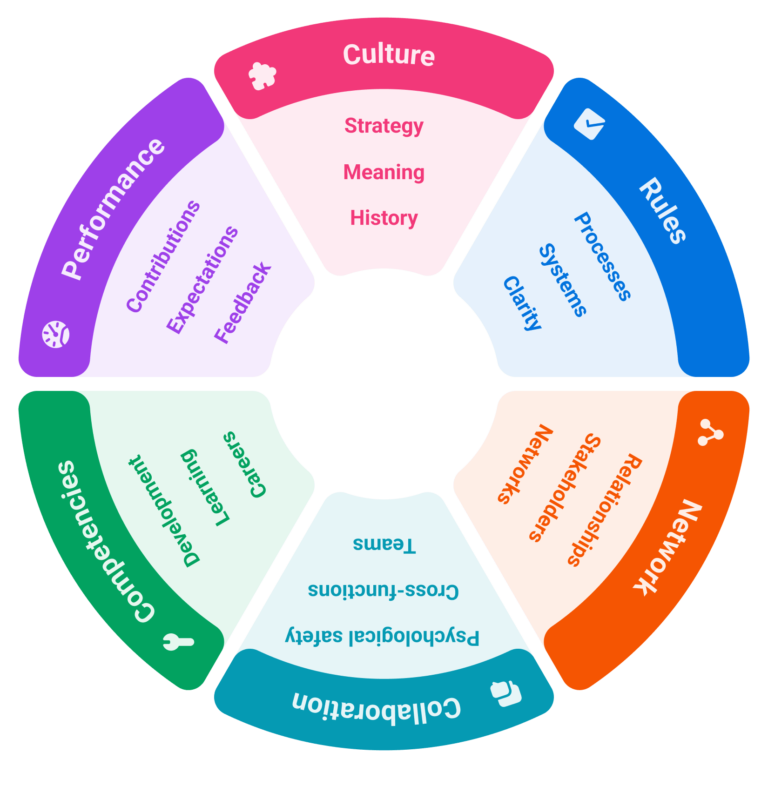
The six dimensions should be read as different needs — and therefore as six different types of signal.
The six dimensions, read as signals
CULTURE
LOW SCORE
The employee hasn’t yet gained access to the unwritten rules, the history, and the direction, not necessarily that she’s pushing back against them. Early in the process, a low score is less concerning than the same score after six months.
HIGH SCORE
She has a clear picture of how things fit together here. Culture is often the dimension that takes the longest to learn, so the timing of the measurement matters greatly.
RULES
LOW SCORE
Often points to practical gaps: missing system access, unclear roles and responsibilities, or procedures no one has walked through. This is often the easiest dimension to fix.
HIGH SCORE
The practical foundation is in place. That frees up the employee’s capacity to focus on what’s harder to learn.
NETWORK
LOW SCORE
The employee lacks access to the right relationships or the informal groupings that shape how work gets done. This is rarely about personality — more often about whether active introductions have been made.
HIGH SCORE
She has found — or been given — access to the network that makes it possible to get things done.
You’re reading a chapter in our new blog series on understanding and improving organizations’ ability to onboard new employees.
You are currently reading: Chapter 6: Six dimensions, six signals: What does a high or low score actually mean?
Read also:
Chapter 1: Most organizations ask about satisfaction. That’s the wrong question
Chapter 2: Six dimensions, one model: What good onboarding actually looks like
Chapter 3: From data to dialogue: What a dialogue report can do for your onboarding
Chapter 4: The index: How we track progress – and benchmark against others
Chapter 5: What benchmarks tell us about onboarding across age groups
Chapter 7: The onboarding curve: The experience doesn’t just improve over time – Coming soon
Chapter 8: The onboarding calendar: Does it matter what time of year you hire? – Coming soon
Chapter 9: From diagnosis to action: How to build a catalog that matches the data – Coming soon
Chapter 10: From data to prediction: What AI can do for onboarding – Coming soon
Three more signals
COLLABORATION
LOW SCORE
Can stem from relationships with her closest manager, colleagues, or across functions. Worth identifying which of the three is driving the score — the fixes differ significantly.
HIGH SCORE
The employee has found her place in the day-to-day working relationships — not just learned her own tasks.
COMPETENCIES
LOW SCORE
Often points to one of two opposite problems: she doesn’t yet understand the jargon, or she isn’t being allowed to use the competencies she already brings. Same score — very different fixes.
HIGH SCORE
There’s a good balance between challenge and mastery. She’s neither overwhelmed nor bored.
RESULTS
LOW SCORE
She’s unsure what’s expected of her, or doesn’t feel that what she delivers makes a difference. Either can undermine motivation.
HIGH SCORE
She knows what to prioritize, and experiences the work as mattering.
When the signals line up
The six dimensions are rarely best read in isolation. As we wrote in article 2, they’re connected — and that holds true when interpreting them as well.
LOW NETWORK
+ LOW CULTURE
Often points in the same direction: the employee is isolated from the people who could have taught her both.
LOW COMPETENCIES
+ HIGH RULES
The practical side is in place, but no one has given the employee permission — or a challenge — to actually use her abilities.
The individual score tells you where to look. The pattern across dimensions tells you why.
The score is a snapshot — not the final result
For those of you managing onboarding across multiple teams, this is often where the real diagnostic value lies — not in any single score, but in which combinations recur across your organization. A recurring low-network-plus-low-culture pattern in one department is a different problem than the same pattern showing up in a single individual, and it calls for a different kind of fix.
It’s worth remembering that every score is a snapshot, taken after 1, 3, or 6 months. A low score after one month isn’t necessarily cause for concern — it can easily rise substantially by the next measurement, as the employee finds her footing.
That raises a natural question: what does that movement actually look like over time? Does the onboarding experience climb steadily, or does it fluctuate — with dips along the way that are entirely normal, but hard to spot if you’re only looking at one measurement point at a time? That’s the subject of the next article in the series.
Before you move on, read how FastTrack can improve your onboarding process. FastTrack is part of HR-ON Boarding+.
THE CRUCIAL SHIFT
Move from reading the score as a verdict to using it as a signal for where onboarding needs a closer look.
Move from reading the score as a verdict to using it as a signal for where onboarding needs a closer look.
You might also like: Most organizations ask about satisfaction. That’s the wrong question
About the author
- Christian Harpelund is a qualified organizational psychologist and works with HR-ON as an onboarding expert
- He is the author of “Onboarding: Getting New Hires off to a Flying Start” and has a new book coming soon, “Kunsten at onboarde en leder” (in Danish)
- He delivers courses and gives talks on onboarding and the organizational frameworks that support effective leadership
FAQ: What do onboarding scores actually tell you?
What does a low onboarding score mean?
A low score usually signals that a specific onboarding need has not yet been met. It does not necessarily mean there is a problem with the employee.
What does a high onboarding score mean?
A high score shows that something is working well. However, it is still useful to understand what is driving the score and whether it is part of a consistent onboarding effort.
Why should onboarding dimensions be viewed together?
Patterns across several dimensions can reveal more than one score alone. They can help explain what may be causing a challenge and where to take action.
Does the timing of the onboarding survey matter?
Yes. A low score after one month can mean something very different from the same score after six months, because onboarding develops over time.
How should managers use onboarding scores?
Use the scores as signals for where to look more closely. They can help managers identify areas that may need clarification, support, or adjustment.