

What actually makes people apply? An analysis of job ad best practices
The short answer: clear, honest job ads get more applicants. Across 1,276 job ads, inclusive wording was linked to up to 52.1% more applicants, a clear Employer Value Proposition to 36.1% more, and dropping clichés to 32.8% more.
Short summery (TL;DR)
An analysis of 1,276 job ads shows how clear, inclusive language and relevant information can help attract more applicants.
In this article, you will learn:
- How inclusive language can attract more applicants
- Why a clear Employer Value Proposition (EVP) matters
- How to improve job ads by avoiding clichés, jargon, and unnecessary requirements
In short, clear, honest, and inclusive job ads are associated with more applicants and can help organisations attract a wider range of candidates.
We’ve all been there. A role needs filling, the hiring manager wants it posted yesterday, and the job ad gets pieced together from an old template, a few bullet points and a “we’re looking for a self-starter” for good measure. Then we wait, and wonder why the applications trickle in.
We’ve worked with a lot of companies over the years and seen millions of job ads. We’ve also talked with plenty of experts about what makes candidates click “apply”. Expert opinion is useful, but we wanted to see what the data says.
This paper shares what we found in one of our studies. We looked at 1,276 job ads from five European organisations in regulated or infrastructure-related sectors, and asked a simple question: which parts of a job ad go hand in hand with more applicants?
The good news is that none of this needs a big budget or a dedicated employer branding team. Whether you’re a one-person HR function or part of a large talent acquisition team, every finding here is something you can act on in your next job ad.
The findings at a glance
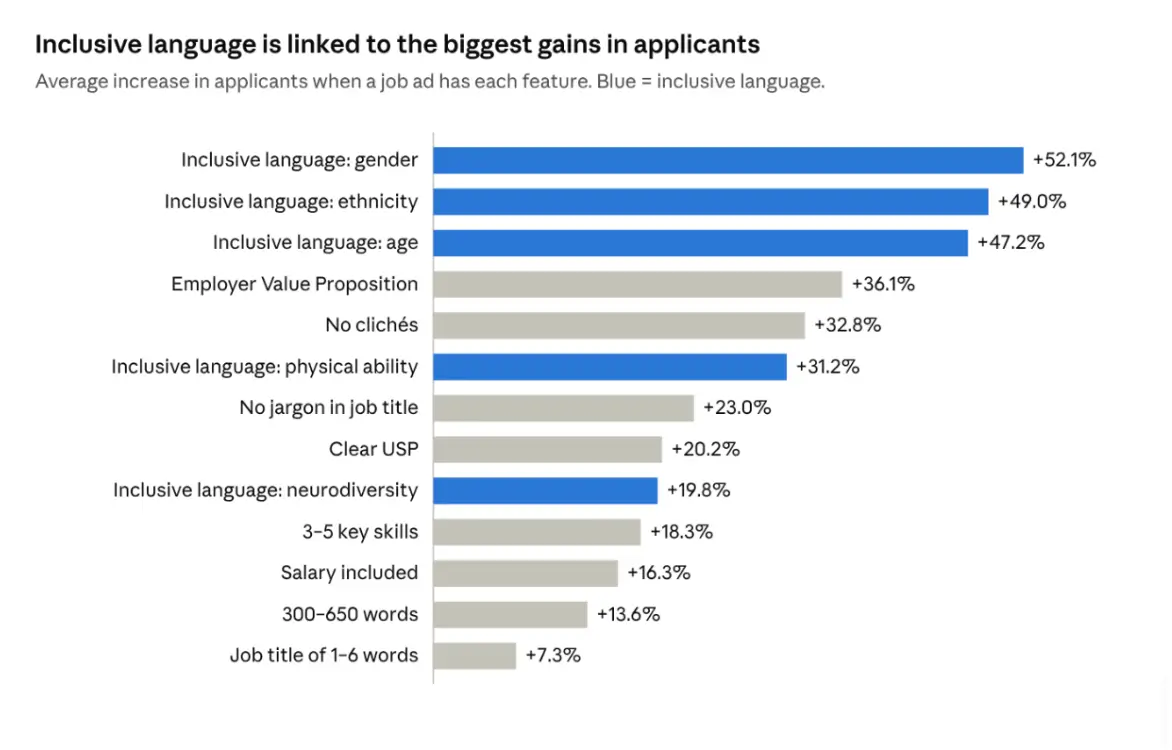
Our study of 1,276 job ads from five European organisations
Language takes five of the top six spots. How you word an ad seems to matter as much as what you put in it.
How we did it
We compared like with like, so that a senior engineering role in one country wasn’t stacked up against a junior admin role in another.
1. We grouped the ads by company, department, seniority, and country.
2. A group only counted if it had at least three ads with the feature in question and at least three without it.
3. In each group, we worked out the average number of applicants for ads with and without the feature, and the percentage difference between them.
4. We then averaged those differences across all the groups to estimate the overall impact of each feature.
We looked at Employer Value Proposition (EVP), pay transparency, skill descriptions, clichés and jargon, ad length, job title clarity, unique selling points (USPs), and inclusive language across age, gender, ethnicity, physical ability, and neurodiversity.
One honest caveat up front: these are correlations, not guarantees. An ad with a strong EVP is probably also better written in other ways. But when the same patterns keep showing up across many groups, they’re worth paying attention to.
Tell people why they should work for you
The biggest single non-language win in the study: ads that included an Employer Value Proposition saw 36.1% more applicants on average.
Employer Value Proposition: +36.1%
Your EVP is the mix of benefits, values and experiences you offer as an employer. Put simply, it’s your answer to the candidate’s quiet question: “What’s in it for me?” In the study, 146 ads included an EVP and 150 didn’t.
When it’s communicated clearly, an EVP helps your ad stand out in a sea of similar-looking postings. It also attracts people who actually fit your culture and mission, which matters long after the hire.
You might also like: Job interviews and the Halo Effect: A hidden bias we need to tackle
Unique selling point: +20.2%
Ads with a clear USP drew 20.2% more applicants (216 ads with a USP, 197 without). Where the EVP is the overall package, the USP is the thing that makes you different. That might be your mission, the growth opportunities, or the team people will be joining.
A USP helps candidates connect with the company, not just the job title, and it builds your employer brand one ad at a time.
Try this: Before you write the duties, write one or two sentences that only your organisation could say. If the sentence would fit just as well in a competitor’s ad, it isn’t a USP yet.
Words matter more than you think
How you say it turned out to be just as important as what you say. The three language findings were among the strongest in the whole study.
Drop the clichés: +32.8%
Ads without clichés attracted 32.8% more applicants (178 ads without clichés, 90 with). Phrases like “rockstar” or “self-starter” feel harmless, even fun, when you write them. To a candidate, they’re vague. They make the ad harder to understand and can put off exactly the qualified people you want.
Skip the jargon in job titles: +23%
Job titles without jargon brought in 23% more applicants (153 titles without jargon, 160 with). Internal names, abbreviations and creative titles might make sense inside your organisation, but candidates don’t search for them. A plain, descriptive title is easier to find and easier to understand.
Use inclusive language: up to +52.1%
This was the standout finding. Ads that scored high on inclusive language consistently drew more applicants, across every dimension we measured.
Dimension
Gender
Ethnicity
Age
Physical ability
Neurodiversity
Increase in applicants
+52.1%
+49.0%
+47.2%
+31.2%
+19.8%
High-scoring ads
85
59
56
52
51
Low-scoring ads
283
233
254
231
226
The words in an ad send signals about who is welcome. Small, unintended biases in wording can quietly turn away whole groups of people. Notice too how few ads scored high: in every dimension, low-scoring ads outnumbered high-scoring ones by more than three to one. That’s a big opportunity hiding in plain sight.
Try this: Read your ad as if you were someone different from the last person who held the role. Would you feel invited to apply?
You might also like: Every Candidate’s Experience Matters: Easy Steps to Ensure Fairness in Recruitment
Make it easy to read and easy to say yes to
The practical stuff adds up too: focused skills (+18.3%), pay transparency (+16.3%), the right length (+13.6%) and short titles (+7.3%) all went hand in hand with more applicants.
List 3 to 5 skills that really matter: +18.3%
Ads listing 3 to 5 well-defined skills saw 18.3% more applicants (84 ads with 3–5 skills, 164 with more or fewer). We all know the wish-list ad that asks for twelve “must-haves”. It tends to scare off good people who tick eight of them. A short, focused list lowers the barrier while still helping candidates judge whether they’re a fit.
Show the salary: +16.3%
Including salary information led to 16.3% more applicants (93 ads with pay transparency, 130 without). Beyond the numbers, it shows openness, fairness and respect for people’s time. It’s also becoming a legal matter: the EU Pay Transparency Directive is moving in the same direction, making it important for employers to prepare for the requirements as they are introduced across EU countries.
Keep the ad between 300 and 650 words: +13.6%
Ads in that range drew 13.6% more applicants (144 ads within 300–650 words, 104 outside it). A job ad isn’t a job description. Its job is to get the right people interested, so keep it focused and easy to scan. The full list of responsibilities can come later in the process.
Keep job titles to 1–6 words: +7.3%
Titles of 1 to 6 words saw 7.3% more applicants (50 concise titles, 109 longer ones). The effect is smaller than the others, but titles are the first thing candidates see and what search engines and job boards pick up. Short and descriptive wins.
You might also like: AI in recruitment: The Opportunities – and the Responsibility
What this means for you, whatever your company size
None of these changes cost money; they cost a bit of attention. That’s why they work for every HR team.
If you’re a small business or a one-person HR team, you probably can’t outspend bigger employers on branding. You don’t need to. Clear wording, a salary range and an honest line about what makes you different are free, and the data links them to more applicants.
If you’re a mid-sized company, you likely have a handful of people writing ads, each in their own style. A shared template built around the checklist below keeps quality consistent without slowing anyone down.
If you’re in a large organisation, small improvements multiply across hundreds of ads. Even the modest wins, like shorter titles, add up when they’re applied to every posting.
Your job ad checklist
Run through this before you hit publish:
☐ The ad says why someone should work here (EVP)
☐ It includes at least one thing only we could say (USP)
☐ The salary or salary range is included
☐ The job title is 1-6 words, with no internal jargon
☐ The ad is between 300 and 650 words
☐ It lists 3-5 clearly defined key skills
☐ No clichés such as “rockstar” or “self-starter”
☐ The wording is inclusive across gender, ethnicity, age, physical ability and neurodiversity
The bottom line
Small, deliberate changes to a job ad can make a real difference to how many people apply.
Three patterns kept coming back:
• Clear, relevant information gets more responses.
• Jargon, clichés and unnecessary complexity shrink your reach.
• Inclusive, human language attracts bigger and more diverse applicant pools.
No single change explains everything, and every recruitment market has its own quirks. The data in this study comes from five European organisations in regulated or infrastructure-related sectors, so your results may look different. But the direction is clear, and it supports something many of us already sensed: a thoughtful, human job ad is worth the extra effort.
You might also like: 5 steps to create an Ideal Candidate Profile – a no nonsense approach
How can you write a job ad that attracts more applicants?
What makes a job ad attract more applicants?
Clear, honest and inclusive language is associated with more applicants. An analysis of 1,276 job ads found that inclusive wording, a strong Employer Value Proposition (EVP) and avoiding clichés were among the factors most strongly associated with higher applicant numbers.
Why is inclusive language important in job ads?
Inclusive language helps job ads appeal to a wider range of candidates. The study found that job ads with more inclusive wording attracted up to 52.1% more applicants. Avoiding biased or exclusionary language can help more people feel encouraged to apply.
How can an Employer Value Proposition improve a job ad?
An Employer Value Proposition (EVP) explains why candidates should want to work for a company. It highlights benefits, values and experiences that make the workplace attractive. In the study, job ads with a clear EVP were associated with 36.1% more applicants.
How long should a job ad be?
According to the study, job ads between 300 and 650 words attracted 13.6% more applicants than shorter or longer ads. Keeping job ads focused, easy to read and free from unnecessary details can help candidates quickly understand the role.
Should you include salary information in a job ad?
Including salary information helps candidates understand what to expect and supports greater transparency. The study found that job ads with salary information were associated with 16.3% more applicants compared to ads without it.